Skip to content
The Black Friday sale is here: every product is included | Text us first for your deal: 866-383-7258 The Black Friday sale is here. Text us!

Solar Pond Fountains

Black Friday

Black Friday is here. Text or call 866-383-7258 to get your deal.

See the sale
  • Price Beat Promise
  • Free returns on eligible orders
  • Free shipping over $99
  • Text or call 866-383-7258

Solar Powered Pond Fountains for When Electricity Is Out of Reach

You want a beautiful fountain in your pond. You don't want to spend a fortune digging up your property just to power it.

That's the problem solar powered pond fountains solve.

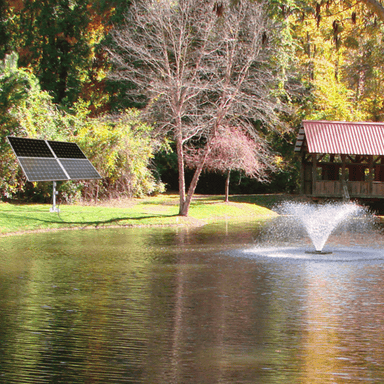
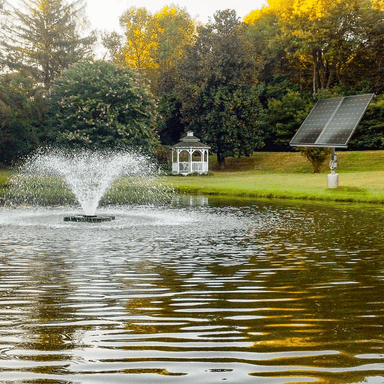
For ponds without nearby electrical service, these floating fountains create an attractive water display using energy from solar panels instead of electricity from the utility grid. They're particularly useful for farms, private estates, parks, and properties where running power to the water would be difficult or expensive.

And we're not talking about little garden fountains with a solar panel floating beside them. These are substantial systems from Airmax and Scott Aerator, built to create a visible display on larger ponds while providing some surface aeration.

But solar isn't automatically the best choice for every pond. Here's what we want you to know before spending the money.

Why Solar Pond Fountains Can Be Worth the Higher Price

Most customers who call us about solar fountains aren't necessarily passionate about renewable energy.

They just don't have electricity anywhere near their pond.

If your electrical source is 300 feet away, running power might still be the more affordable option. But if it's 1,000 feet away, you're looking at a different situation.

Trenching, properly sized electrical wire, junction boxes, control equipment, and professional installation can add up quickly. Long electrical runs also create voltage drop concerns that have to be addressed when designing the system.

And sometimes distance isn't even the biggest problem. It's what's standing between the pond and the power source.

Solar fountains usually cost more upfront than comparable electric models, but avoiding those installation expenses can make the overall project more affordable.

On the other hand, if you've already got electricity near your pond, we'd encourage you to look at our pond fountains. That collection includes conventional electric fountains with more spray pattern choices, consistent operating schedules, and options for nighttime lighting.

The goal isn't to sell you solar just because you asked about it. It's to help you figure out which option makes the most financial sense for your property.

What Happens to a Solar Powered Fountain When the Clouds Roll In?

Here's something that catches some buyers off guard.

The sun determines how impressive your fountain looks throughout the day.

The direct drive solar fountains we carry use electricity produced by their solar panels as sunlight becomes available. They don't rely on batteries to keep the fountain operating at full power.

When sunlight first reaches the panels in the morning, you may see a short spray. As the sunlight gets stronger, the fountain can gradually reach its full height and width.

Then a cloud rolls in, and the display may shrink again.

That's normal.

These systems are designed for daytime operation, so once there's no longer enough sunlight, the fountain stops.

It's also why we don't recommend standard solar fountains to customers whose main goal is a beautiful illuminated display at night. Some fountain models may be compatible with optional lighting equipment, but the standard solar setup doesn't provide power for a nighttime fountain display.

If you want the same impressive spray every evening, regardless of the weather, conventional electricity is probably a better investment.

Why Large Solar Pond Fountains Need More Than a Tall Spray

A fountain that shoots water 15 feet into the air sounds impressive.

But what if that spray is only 3 feet wide?

From the other side of a large pond, you might barely notice it. All you'll see is a skinny stream of water.

That's why we pay just as much attention to spray width and pattern as we do to height.

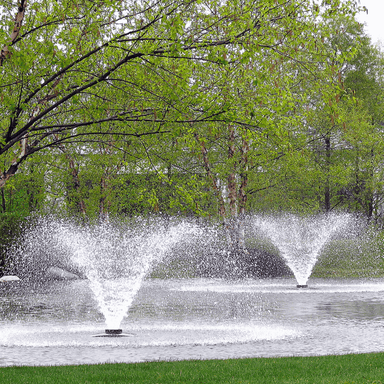
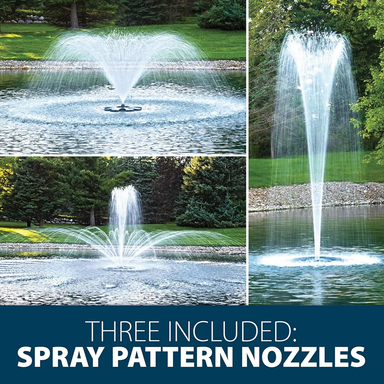
We particularly like the Crown & Trumpet pattern on the Airmax SolarSeries because it combines height with a wide, attractive display. The Scott Aerator DA20 creates a different look, with a cascading spray that emphasizes water movement.

Another important consideration is where the fountain sits in the pond.

A solar fountain doesn't have to be installed in the center of the water, especially if appearance is your main priority.

Positioning it 50 feet from shore rather than 200 feet away can make a tremendous difference in how the display looks from your house, patio, or driveway.

A properly positioned fountain can look impressive on a large pond without needing the tallest spray available.

Choosing Between Airmax and Scott Aerator Solar Fountains

We carry solar pond fountains from Airmax and Scott Aerator, but we don't recommend them for exactly the same reasons.

Airmax SolarSeries: A great choice when appearance comes first.

The Airmax SolarSeries includes three spray patterns: Classic, Trumpet, and Crown & Trumpet.

That gives you some flexibility in how your fountain looks without replacing the entire system. We especially like the Crown & Trumpet display for its balance of height and width.

Scott Aerator DA20: Our preference when surface aeration matters, too.

The Scott Aerator solar DA20 has a wider, cascading spray designed to move water and promote surface oxygen exchange.

The solar models are available in 1/2 HP and 3/4 HP configurations. Keep in mind that their water movement and spray performance differ from comparable electric DA20 fountains.

Neither manufacturer is automatically the better choice.

When customers call us, we start with three questions. How deep is your pond? Do you have good sunlight for the panels? And are you looking primarily for a decorative display or meaningful surface aeration?

Those answers usually tell us which direction to go.

Your Solar Panels Matter More Than You Might Think

You can buy an excellent solar fountain and still end up with a disappointing display if the panels aren't getting enough sunlight.

We generally recommend a location with good southern exposure and minimal shading, especially between approximately 9 a.m. and 3 p.m.

Even partial shade can reduce how much electricity the panels produce. A tree that blocks sunlight for several hours each afternoon might prevent the fountain from operating at its full potential.

And here's another detail that surprises customers.

The mounting poles aren't always included.

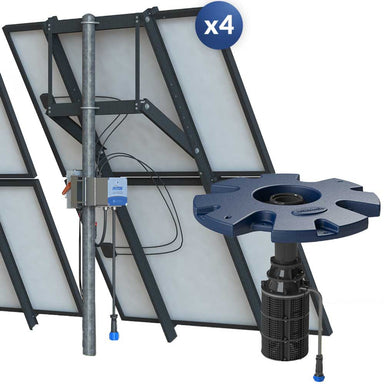
Some manufacturers provide the solar panels and mounting frames but require you to supply the mounting poles and foundation materials locally.

The poles are often left out because of shipping costs and because the appropriate height depends on your installation.

You also need to consider cable length, anchoring, and how far the fountain will sit from the solar array.

It's worth working through these details before ordering rather than discovering you're missing important installation materials when everything arrives.

Can a Solar Fountain Really Aerate a Large Pond?

Solar fountains provide water movement and surface oxygen exchange. But that doesn't mean every solar fountain can properly aerate an entire pond.

And we think that distinction matters.

A shallow pond with a relatively simple shape has different aeration needs than a deep pond with irregular shorelines, islands, and sheltered sections.

For example, if you called us about a one acre pond that's 12 feet deep and said your primary concern was oxygen levels, we probably wouldn't recommend relying on a solar fountain alone.

Instead, we'd want to look at how to circulate the deeper water.

Our pond aerators include surface aerators and bottom diffused systems intended to improve pond circulation and oxygen conditions rather than simply producing an attractive spray.

But what if you don't have electricity near the pond?

That's where our solar pond aerators come in. This collection includes dedicated solar aeration systems, including bottom diffused equipment that uses underwater diffusers to circulate water from deeper areas of the pond.

A solar fountain is primarily about creating a visible water display with the added benefit of surface aeration.

A dedicated solar aerator is about improving water movement and oxygen conditions without needing a decorative fountain.

Choosing between them depends on what problem you're trying to solve.

A Real Customer Story: When Solar Saved a Park From More Construction

We recently worked with a customer who wanted fountains for two ponds in a public park.

The park had already invested in dredging work, and the ponds were looking beautiful. The last thing the customer wanted was another major construction project tearing up the property.

Unfortunately, bringing electricity to both ponds was going to be a headache.

They would have needed to trench through roads and walking paths, divide electrical service between two locations, and potentially run wiring across property belonging to another company.

And the electrical source wasn't even especially far away.

After getting quotes for the electrical work, it became clear that conventional fountains weren't the most practical option.

Solar made more sense.

The project involved nearly a year of planning. We helped connect the customer with an installer in his own town, and once the fountain was ordered, the first installation was completed and operating in less than a month.

The larger pond now has its fountain, and a matching solar fountain for the smaller pond is planned for the next phase.

That's a perfect example of why we consider more than the distance to the nearest electrical outlet.

Sometimes avoiding the construction is the biggest benefit of going solar.

Solar Fountains Still Need Maintenance

Solar power eliminates the need for utility electricity at the pond, but it doesn't make the equipment maintenance free.

The solar panels need to stay clean enough to produce electricity efficiently.

If your pond sits near a farm field or dusty road, you might need to clean them more frequently. Snow accumulation can also reduce production during winter if the system is intended to operate in colder weather.

The fountain itself still needs normal care. That means checking for clogged intakes, keeping nozzles clear, inspecting anchors, and following the manufacturer's maintenance recommendations.

You'll also have solar equipment and electrical controls to inspect.

It's not particularly complicated, but it is something to plan for.

Let's Make Sure Solar Is the Right Choice for Your Pond

Before spending thousands of dollars on a solar fountain, let's make sure it will actually deliver what you're expecting.

We can help you compare solar fountain displays, evaluate your pond depth, choose a suitable location for the panels, and work through the installation requirements.

We'll also tell you if we think a conventional electric fountain or dedicated aeration system would be a better investment.

Call or text Everblue Pond at 866-383-7258.

A few minutes discussing your pond now can save you a lot of expense and frustration later..

Solar Pond Fountain FAQs

Do solar pond fountains work on cloudy days?

Yes, solar pond fountains can operate during cloudy conditions, but their performance depends on how much sunlight reaches the panels. As sunlight decreases, the fountain's spray height and width may become smaller. If there's not enough solar power available, the fountain can stop entirely. For the most consistent daytime performance, position your solar panels where they'll receive plenty of direct sunlight without significant shade from trees or buildings.

Can solar powered pond fountains run at night with lights?

The standard direct drive solar fountains we carry operate using available sunlight and don't include batteries for nighttime operation. Once there's insufficient sunlight, the fountain stops. Although some models may accept optional lighting equipment, that doesn't mean the standard solar system can produce an illuminated display at night. If nighttime lighting is important, we generally recommend considering a conventional electric fountain instead.

Can I install a solar fountain in a large pond?

Yes. Solar fountains can create attractive displays on larger ponds, but the fountain's position and spray dimensions make a big difference. A narrow spray can look surprisingly small when viewed from a distance. We recommend considering the spray width, viewing location, available cable length, and pond depth rather than choosing based on spray height alone. If aeration is also important, the amount of water the fountain moves needs to be considered separately.

Do solar pond fountain kits include everything needed for installation?

Not always. Solar fountain packages generally include the fountain, solar panels, and necessary electrical control components, but mounting poles, foundation materials, and anchoring supplies may need to be purchased separately. The included equipment varies by manufacturer and model. You'll also need to plan the distance between the solar panels and fountain, since power cord lengths vary. We recommend confirming the complete installation requirements before placing your order.

Are solar pond fountains good for aeration?

Solar pond fountains help improve surface water circulation and oxygen exchange, but they aren't necessarily suitable for aerating an entire pond. Their effectiveness depends on water flow, pond size, depth, shape, and daily operating time. Deep ponds or ponds with complex shapes may benefit more from bottom diffused aeration. If improving pond health is your primary goal, we recommend evaluating your aeration needs separately before choosing a decorative solar fountain.